The government supports the ban on women’s entry into Sabarimala in the Supreme Court
The final hearing in this case is likely to be completed by 7th April 22nd.
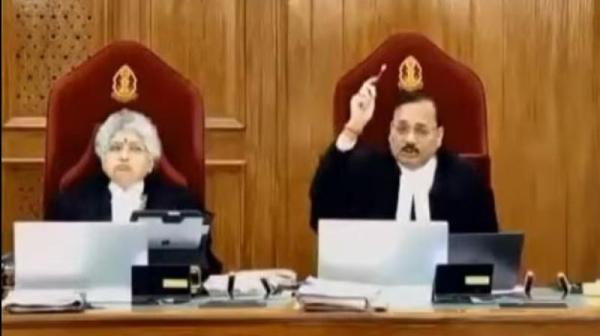
New Delhi. The Central Government told the Supreme Court that the ban on entry of women of menstrual age into the Sabarimala temple in Kerala falls within the ambit of autonomy of religious faith and sect, and is beyond the scope of judicial review.
Tushar Mehta, appearing for the Center in the Sabarimala temple case in Kerala, told the nine-judge Constitution bench that if any practice is inconsistent or unscientific, then the solution lies with the legislature.
In this bench headed by Chief Justice Surya Kant, Justice B. V. Nagarathna, Justice M.M. Sundaresh, Justice Ahsanuddin Amanullah, Justice Arvind Kumar, Justice Augustin George Masih, Justice Prasanna B. Varale, Justice R. Mahadevan and Justice Joymalya Bagchi.
Mehta told the bench that we have to respect the traditions of every sect. Not everything is about dignity or physical freedom. If I go to a shrine or a gurudwara and have to cover my head, can I say that my dignity, rights or choice have been ignored?
Mehta said that if a person claims that human sacrifice is a mandatory religious practice and approaches the court under Article 32 of the Constitution, the court need not examine whether the practice is religious or mandatory but can directly reject it on the grounds of violation of public order, morality or health.
Mehta said that we want to tell the court clearly that it should not review the practices in a manner in which it is asked whether a practice is ‘rational’, ‘modern’, ‘scientifically correct’, ‘consistent with judicial thinking’, ‘unpopular’ or based on ‘constitutional change or principles of morality’. Doing so is not constitutional review.
Mehta said that there is no clear definition of ‘constitutional morality’ given in the Constitution.
The Center told the court that it is noteworthy that ‘constitutional morality’ is not directly present in the Constitution. It is a judicially developed, vague and undefined concept. Therefore, expanding the term ‘morality’ which is clearly included in the Constitution as ‘constitutional morality’ would not only amount to judicial interference but would also amount to an amendment to the Constitution. Initially, the Supreme Court asked the lawyers of all the parties to adhere to the stipulated time limit and also clarified that no additional time will be given as other important matters are also pending.
The hearing of the case continues
In September 2018, a five-judge Constitution bench by a 4:1 majority had struck down the ban on entry of women aged between 10 and 50, holding it illegal and unconstitutional. Later on 14 November 2019, a bench headed by then Chief Justice Ranjan Gogoi had referred the issue of discrimination against women to a larger bench by a majority of 3:2. In this decision, not only Sabarimala, but also the issues of entry of Muslim women into mosques and dargahs and entry of Parsi women married to non-Parsi men into Agiyari (sacred fire place) were referred to a larger bench. The apex court had said on February 16 that the final hearing in this case would begin from April 7, which is likely to be completed by April 22.
Contact to : xlf550402@gmail.com
Copyright © boyuanhulian 2020 - 2023. All Right Reserved.