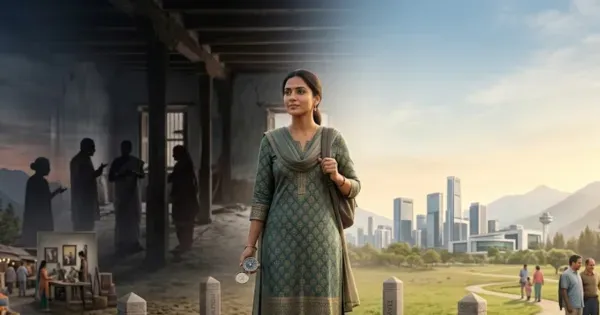
Since childhood, a woman is taught to read the minds of others before her own – how to sit, how much to speak, when to return, what to wear, how to manage the family and which dream is 'practical'. His responsibilities are decided more than his desires. In such a situation, when she is asked- 'What do you want?' So how should he respond to her desire? He was rarely asked what he really liked. The real question of woman's freedom begins from here – has she got the opportunity to recognize her desire and choose it?
role-bound childhood
Right from childhood, a girl's future is tied to relationships and responsibilities – being a good daughter, sister, wife, daughter-in-law and mother. The boy is asked – 'What will you become?', the girl – 'How will you play?' He is taught to play roles before choosing the path. Gradually his identity begins to be determined not by desires but by responsibilities. The problem is more than the lack of opportunities, it is the practice of identifying one's desires and choosing the future.
Invisible guard of 'good girl'
The image of the 'good girl' gradually becomes the norm within – ask less questions, don't inconvenience anyone, save relationships and put others before yourself. This learning guards every decision. If you change job, then home, if you go out alone, then society, if you get married, then family, and if you change your wish, then the feeling of guilt comes to the fore. Then even one's desire does not seem to be one's own; permission seems necessary before fulfilling it. This conditioning is also often passed down through mothers and women in the family, who themselves grew up in this system. To break this, not only men but the entire family will have to be made aware.
among everyone, away from yourself
The woman of the house knows everyone's needs – who needs what, whose work is due when. But ask- 'What do you want?' So the answer is- 'Nothing.' This 'not always satisfying' may also be the effect of postponing desires for years. While taking care of others' priorities, she forgets her own desires. Therefore, women's liberation is not only a right but also a place to recognize one's desires. It also impacts mental health – guilt, fatigue, blurring of identity and sometimes depression or burnout. Recognizing your desires is not only a question of freedom, but also a question of health.
Right to your 'yes'
It was necessary to teach a woman to say 'no', but freedom is not complete there. She also has to decide what her 'yes' is for – career or financial freedom, marriage or loneliness, motherhood or ownership of one's time, big success or a peaceful life. Every woman's desires are different. Freedom does not mean living the same life, it means choosing the meaning of your life.
there is no measure of desire
There is also a pressure to link women's freedom with big achievements – big job, business, abroad or awards. Whereas sometimes his desire may just be to sleep without responsibilities, drink tea alone, read a book, meet friends, work or leave a job or not answer to anyone for some time. Desire is not big or small. A man's choice is easily accepted, a woman is still asked – 'Why?' Why is there a need to prove his every wish useful?
Ask your daughter about her life, not her profession.
Don't just ask your daughter – 'What will you become when you grow up?' Sometimes also ask – 'What kind of life would you like to live?' Don't take his/her response as immediate advice or 'practical' thinking. Today a doctor, tomorrow an artist, today a metropolis, tomorrow a small town – his choice can change. The right to change one's wish is also freedom. The daughter needs the freedom not only to take decisions but also to change them and when she changes her answers, do not call her 'unstable' – the right to change is also a part of freedom.
You got freedom, where did you get your voice?
Education, employment, economic self-reliance and legal rights have opened doors for women, but one door within is still closed. Before every wish the question arises – 'What will people say?' He needs as much freedom to choose wrong, get tired, stop, change his mind and start again as he needs to be successful. True freedom is about going out and finding your voice. Liberating a woman and letting her decide for herself the meaning of freedom are two different things. Education and economic self-reliance are necessary, but alone not sufficient. As long as there is fear of 'what will people say' and the respect of the family, the inner voice will remain suppressed.
Want to leave behind 'I don't know'
Till now the question remained – what were women not allowed to do? The next question should be – what did he stop wanting? When she is asked, 'What do you want?' And if you get the answer – 'I don't know', then don't consider it a weakness. It will take time for someone who has spent his whole life reading the wishes of others to recognize his own wishes. Instead of pressing him for an answer, he has to say – 'Don't be in a hurry, first look within yourself.' Women's liberation does not lie only in getting opportunities like men, but in choosing their own life. Whether to become a mother or not, whether to choose a career or a quiet life, to get married or to live alone. Every election should get equal respect. There will be true freedom when one's will does not need permission and his choice does not need clarification. Then 'What do you want?' Not just questions, there will be an open door – where there will be no fixed role, only one woman, with her own voice, her own identity and her own wishes.
– Kriti RK Jain, Writer
Contact to : xlf550402@gmail.com
Copyright © boyuanhulian 2020 - 2023. All Right Reserved.