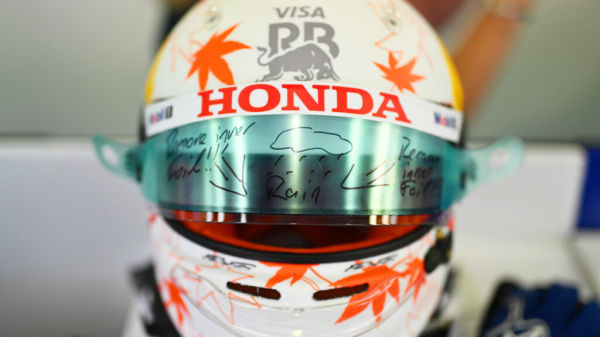
Formula 1 is a sport widely known for its many technological innovations. From the Golden Era of the 1960s to 1970s with aerodynamic advances, to the Turbo Era of the 1980s, the screaming engines of the 2000s, to the modern Hybrid Era, it’s a sport dripping with cutting-edge tech, all in the name of making the fastest form of circuit racing in the world. But not every piece of technology is that advanced — for every lifesaving Halo device, there’s a simple adhesive plastic strip. Enter the visor tear-off.
You know the plastic covering on your phone’s screen when you first buy it? A tear-off is basically a beefed-up version of that. It’s meant to protect the body of the driver’s visor from debris, oil, dirt, scratches, and whatever else comes their way. Once the translucent screen is coated with all this detritus, the driver simply rips it off and presto, you have a clear line of sight again.
The actual number of tear-offs varies, and there’s no readily explained rhyme or reason because it’s more of a soft regulation. In fact, Formula 1’s only hard rule regarding these plastic strips is a directive to keep drivers from throwing them onto the track, which makes sense considering you don’t want a slick piece of plastic right in the middle of a crucial apex. Otherwise, drivers have from around a half-dozen to possibly nine or more; the number likely varies depending on track conditions and other factors.
What exactly are tear-offs made of?
Rosley Majid/Getty Images
Tear-offs exist in just about every circuit racing format featuring closed-helmet, open-cockpit racing, ranging from karting to MotoGP and beyond. Closed-cockpit cars have a similar system despite also having windshield wipers — the film is removed when the driver comes in for a pit stop, particularly useful in long-distance endurance races.
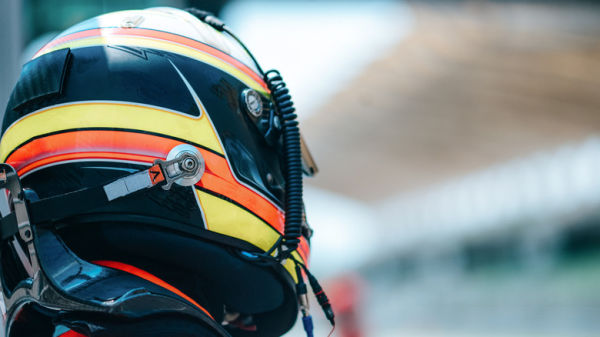
The composition and number of these strips depend on the discipline and manufacturer, but generally you have layers of laminated plastic designed to be torn off sequentially, something like Mylar or a similar material. They stick together to prevent grime from getting between the strips, otherwise stuff like oil and water could separate the layers prematurely. They have to be plastic because they’re bonded to the ballistic material of the visor itself; anything that shatters would never pass muster, considering how bad some crashes can get.
Bear in mind that in a crash, debris like nuts and bolts can be ejected at 150-plus mph, and helmets are designed with those safety considerations in mind. Open-face helmets, let alone stuff that could break, could be a death sentence in a crash at modern F1 speeds. So the visor itself is clearly an extremely resilient material, but nobody said it can’t be scratched or get dirty. And Formula 1 cars have many amazing technologies on-board, but windshield wipers aren’t one of them.
How and when tear-offs are used
Mark Thompson/Getty Images
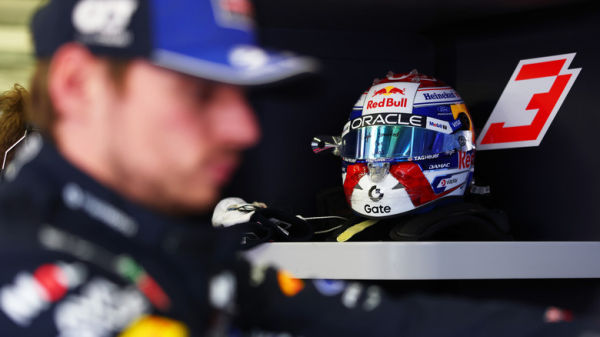
It’s generally up to the driver’s discretion as to how many they use and when they rip them off. It’s common practice to store them somewhere in the car, at least according to contemporary F1 regulations; the practice of tossing them has actually caused accidents before. The most recent example of this is the 2026 MotoGP Spanish Grand Prix, when rider Marco Bezzecchi had an accident before the sprint race even started because his Aprilia slipped on a tear-off.
Formula 1 cars appear more stable than bikes, sure, but the drivers nevertheless drive on the limit of tire grip. Any unpredictable material on the track could change the course of a race instantaneously. Moreover, it’s not like you can simply put more on. You have a finite amount of tear-offs that you decide before the race, so ripping them off after every lap would not only litter the track, but you’d quickly run out of visibility. In other words, it’s an as-needed device, not something to do at set times.
Other motorsports have similar regulations. Take endurance racing, for example. Cars can run longer than five Grands Prix put together, and watching footage of these races often reveals a tear-off every pit stop or so. After all, why bother with the mechanical trouble of wiring in a windshield washer reservoir and pump when a simple piece of plastic will do? Just another way high-level motorsport demonstrates that sometimes the best solution is the simplest one, like how F1 sometimes goes back to old-school pit boards for driver communication when radios fail.