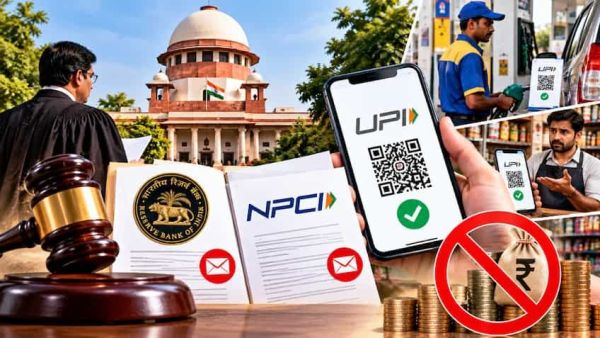
The controversy over the Central Government's decision to impose merchant charges on Unified Payments Interface (UPI), which has become an integral part of the daily lives of 140 crore citizens and crores of merchants across the country, has now reached the threshold of the Supreme Court of the country. The Supreme Court has taken an important step on a public interest litigation (PIL) challenging the new system of imposing 0.4 percent merchant discount rate (MDR) on select person-to-merchant UPI transactions of more than ₹2,000. A three-member special bench comprising Chief Justice of India (CJI) Surya Kant, Justice Joymalya Bagchi and Justice V. Mohana, while conducting the preliminary hearing of the case, has issued a formal notice to the Central Government, Reserve Bank of India (RBI) and National Payments Corporation of India (NPCI) and directed them to clarify the situation.
However, the petitioner has not received any interim relief in this dispute at present. The apex court has clearly refused to impose any kind of stay (Interim Stay) on this new MDR framework which will be effective from 15 October 2026. This simply means that until the next detailed hearing of the case takes place and the court does not give any contrary order, the new rule decided by the government and NPCI will be considered to be in force at the scheduled time. The court has given four weeks time to all the defendants to file their detailed affidavits.
During the hearing, the bench headed by the Chief Justice raised tough questions regarding the legal and policy basis of this new financial charge. The bench asked the Additional Solicitor General who will actually earn from this MDR charge on UPI payments of more than ₹2,000? The court also asked to clarify whether this fee is a tax, service fee or cess? The court also raised the question that when money is transferred from one taxpayer to another through digital medium, what is the statutory basis of the fee charged on this transaction and which tax liabilities or entities are involved in it?
Additional Solicitor General N. appeared on behalf of the Central Government. While clarifying before the court, Venkatraman argued that this is not a new tax or revenue to be collected by the government. He said that MDR is an operational settlement charge shared between banks, payment gateways and service providers to keep the digital payment system smooth, technically secure and financially sustainable. The government will not receive a single rupee from this recovery. The government also underlined that more than 96 percent of general and retail business transactions in the country will be completely free.
As per the new framework notified by the Central Government and NPCI, the main points of the rule, which will come into effect from October 15, 2026, are as follows:
General Person-to-Merchant (P2M) Payments: The MDR charge has been capped at 0.4 per cent on eligible transactions above ₹2,000 at large merchant outlets or e-commerce websites. The maximum charge on large transactions of ₹75,000 or more has been capped at ₹300.
Flat-rate category (Flat MDR): In sensitive and low margin sectors like Railway Ticket Booking, Petrol Pump, Telecommunication (Recharge/Bills), Electricity-Water Bills, Insurance Premium and Agricultural Inputs, a fixed flat MDR of only ₹5 will be levied instead of percentage on payments of more than ₹2,000.
Capital Market Transactions: A concessional MDR of only 0.02 per cent (maximum ₹300) will be applicable on transactions involving mutual funds, securities and stockbrokers.
Who will not have to pay any charge: All person-to-person (P2P) transfers from one consumer to another will be completely free. Additionally, all small shopkeepers and street vendors receiving all daily merchant payments up to ₹2,000 and turnover up to ₹1 lakh per month have been completely exempted under the 'Zero-MDR' category.
This PIL has been filed in the Supreme Court by advocate Anjan Dutta. In the petition, the notification issued by the Central Government in the month of September and the MDR framework of NPCI have been directly challenged. The main argument of the petitioner is that through the changes made in Section 10A of the Payment and Settlement Systems Act, 2007, the executive (government) has got unlimited power to impose arbitrary fiscal charges without any extensive public consultation, solid data and legislative debate, which is a violation of Article 14 (right to equality) and 19(1)(g) of the Constitution.
It has also been argued in the petition that on one hand, RuPay debit card payments have been kept completely fee-free without any monetary limit, while on the other hand, imposing charges on UPI after the limit of ₹2,000 under the same digital ecosystem is discriminatory. The petitioner also expressed serious apprehension that even if on paper this fee is to be paid by the merchant, the businessmen working on low margins will ultimately transfer the burden of this cost indirectly to the pockets of common consumers and customers, which may cause a major blow to the country's Digital India campaign and cashless economy.
Amidst the increasing discussions on this controversy at the political and social level, Finance Minister Nirmala Sitharaman had earlier clarified the situation and said that there is absolutely no need for common citizens to panic about this new rule. He had clarified that not a single extra penny will be deducted by any common citizen for buying vegetables, ration, milk, grocery, cab booking or sending money to friends and relatives. This fee is the Merchant Discount Rate (MDR), which is an internal service charge charged to banks and large merchants to upgrade the technology infrastructure.
At present, digital payment companies, banks and fintech companies have felt some relief due to the Supreme Court not imposing an interim stay, because the preparations for October 15 have not faced a legal setback. However, after four weeks, when the Central Government, the Reserve Bank and NPCI will file their detailed legal case and affidavit in the court, then the final decision will be taken whether this new financial structure will remain based on India's most successful digital payment system or it will have to be overhauled.
Contact to : xlf550402@gmail.com
Copyright © boyuanhulian 2020 - 2023. All Right Reserved.