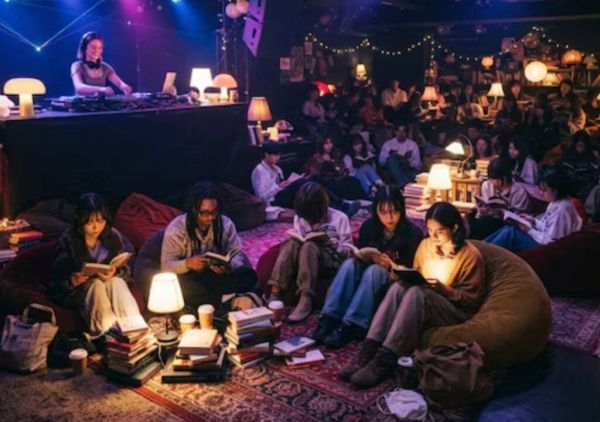
Tokyo: Nightclubs are usually associated with loud music, dancing, drinks and late-night parties. But a new kind of social gathering is turning that familiar setting into something much quieter: people are bringing books to clubs and reading together.
Known as a “reading rave” or “book rave”, the format combines reading with the atmosphere of a nightclub. Instead of dancing, attendees settle into comfortable spaces, open their books and read while ambient music plays in the background.
The trend has recently attracted attention after a video from Japan’s ‘Jucy Book Rave’ went viral on social media. The gathering reportedly took place at Spread, an underground club in Shimokitazawa, Tokyo, where adults could be seen reading in a dimly lit setting while a DJ provided the soundtrack.
The concept may sound unusual, but its appeal lies in precisely that contrast: taking an activity traditionally associated with solitude and placing it in a communal, social environment.
What is a reading rave?
The basic idea is simple. Bring your own book, find a comfortable place and read alongside other people.
Unlike a traditional book club, there is no requirement for everyone to read the same title.
There is also no assigned reading list, deadline or expectation that participants will discuss what they are reading.
The environment may include ambient or electronic music, dim lighting, comfortable seating and drinks or coffee. Depending on the event, participants may also have time to chat before or after the reading session.
Some gatherings incorporate other quiet activities such as journalling, sketching, book swaps or simply relaxing in the space.
The result is somewhere between a reading club and a night out, but without the pressure to constantly socialise.
Alone, but not really alone
One of the more interesting aspects of the format is that it allows people to be alone without being isolated.
Someone can arrive by themselves, choose a book, sit among strangers and spend an hour reading without having to make conversation.
That can be particularly appealing to people who enjoy social environments but do not necessarily want the constant interaction that comes with conventional parties or networking events.
Traditional social gatherings often involve an expectation to talk, participate or meet new people. A reading rave removes much of that pressure.
Everyone is doing their own thing, but they are doing it together.
The shared environment creates a sense of community without requiring direct interaction.
Japan’s Jucy Book Rave goes viral
The recent viral video from Japan has brought the concept to a much wider audience.
The footage from the ‘Jucy Book Rave’ shows adults sitting in a dimly lit club environment, reading books while a DJ plays music in the background.
The setting is designed to feel more like a nightlife experience than a conventional library or reading room.
Reports said the event took place at Spread in Shimokitazawa, an area of Tokyo known for its independent cultural and nightlife scene.
The contrast between the club setting and the quiet activity of reading appears to be a major part of the trend’s social media appeal.
Instead of abandoning nightlife altogether, reading raves essentially rework the idea of what a night out can look like.
It is not quite a book club
Although reading raves share some characteristics with book clubs, the two formats have an important difference.
A conventional book club generally revolves around a particular book. Members read the same work and then meet to discuss its themes, characters, writing style or ideas.
A reading rave removes that shared-reading requirement.
One person may be reading a novel, another a biography and someone else a graphic novel or non-fiction book.
The activity is therefore less about discussing literature and more about creating an environment in which people can enjoy reading alongside others.
That makes the format particularly flexible.

Participants do not have to prepare anything before attending, and they do not have to worry about falling behind a group reading schedule.
From coffee raves to book raves
Reading raves are part of a broader trend of adapting nightlife culture around activities that traditionally happen outside clubs.
Coffee raves, wellness gatherings and even events designed for toddlers have experimented with the familiar idea of a “rave” while changing what people actually do at the event.
The common thread is the atmosphere rather than the activity itself.
A rave traditionally suggests music, crowds and energetic dancing. These newer formats retain elements such as lighting, DJs, social energy and curated spaces while replacing the conventional party activity.
Reading raves take that concept a step further by turning one of the quietest leisure activities into a communal event.
Japan is not the first
Although the Japanese event has attracted considerable attention online, reading raves have appeared in other parts of the world as well.
Earlier this year, a reading rave in Amsterdam gained attention after people gathered to read on the rooftop of the NEMO Science Museum.
Melbourne has also seen the emergence of Book Doof, which organises reading raves in venues including bars, libraries and other unconventional spaces.
These events show that the idea is not limited to traditional literary spaces.
Instead of asking people to visit a library, bookshop or formal reading group, organisers are taking books into places normally associated with nightlife and entertainment.
That change of setting appears to be part of the attraction.
Why are people drawn to the trend?
The popularity of reading raves may be connected to a wider desire for offline experiences.
People spend much of their daily lives surrounded by screens, notifications and constantly changing digital content.
Scrolling through social media can fill spare moments almost automatically, while switching off from digital distractions can require a deliberate choice.
Reading offers one way to make that switch.
A reading rave adds a social element without bringing participants back into the constant interaction of phones and social media.
The setting can also make reading feel like an event rather than another activity squeezed into a busy day.
Instead of staying home alone with a book, participants can go somewhere, meet other readers and still enjoy the quiet concentration that reading provides.
The rise of ‘hobby-maxxing’
Reading raves also fit into a wider interest in deliberately embracing hobbies and offline activities.
From reading retreats and literary tourism to social reading groups and book-themed gatherings, books are increasingly becoming the centre of experiences that extend beyond simply finishing a novel.
The appeal is not necessarily about making reading more productive.
Instead, it can be about making leisure more intentional.
A person who might otherwise spend an evening scrolling on their phone can instead spend the same period reading in a room full of other people doing exactly the same thing.
The activity remains simple, but the environment changes how it feels.
Could reading raves come to India?
The concept has generated interest online, but there does not yet appear to be a major reading-rave movement in India comparable to the events attracting attention in Japan, Amsterdam or Melbourne.
That does not necessarily mean the format would be out of place.
India already has a large network of book clubs, independent bookstores, literary festivals, cafés and cultural spaces where readers gather.
A reading rave would simply introduce another setting and aesthetic to that existing culture.
It could take place in a café after hours, an independent bookstore, a cultural venue or even a nightclub temporarily transformed into a reading space.
The essential ingredients are relatively straightforward: books, comfortable surroundings, suitable music and people willing to spend some time reading together.
A quieter kind of night out
The appeal of reading raves may ultimately lie in their ability to offer something that conventional nightlife does not.
There is no requirement to dance, shout over loud music or constantly meet new people.
Instead, participants can spend an evening immersed in a book while still sharing a physical space with others.
It is a social experience built around individual attention rather than constant interaction.
For readers, that combination may be exactly what makes the format attractive.
Book clubs have existed for generations, and people have always found ways to gather around literature. The newer twist is to take reading out of conventional literary spaces and place it inside an environment associated with nightlife.
The result is a curious hybrid: part reading session, part social gathering and part carefully designed night out.
As more people look for ways to disconnect from screens without disconnecting from others, the reading rave could prove to be less of a novelty and more of another way to socialise.
After all, sometimes the perfect night out may simply involve finding a comfortable corner, opening a good book and being surrounded by people doing exactly the same thing.
Contact to : xlf550402@gmail.com
Copyright © boyuanhulian 2020 - 2023. All Right Reserved.