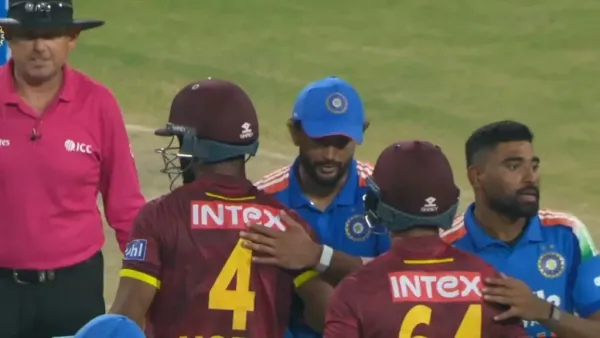
India suffered a shocking defeat against West Indies in the third ODI despite putting 351 runs on the board. What makes this defeat even more concerning is that West Indies effectively had only nine fully available batters during the chase, yet India’s bowling attack still could not defend such a huge total.
One West Indies batter, Jewel Andrew, was injured before the chase and was effectively unavailable to bat unless desperately required. Then Sherfane Rutherford was dismissed in a highly controversial caught-behind decision despite replays appearing to show a clear gap between bat and ball.
Even with these setbacks, West Indies chased down 352 in 48.2 overs and defeated India by five wickets.
Why West Indies Were Effectively Down to ‘Nine Batters’
West Indies suffered a major blow even before beginning their chase.
Jewel Andrew was supposed to open the innings but suffered a finger injury and had to be taken to hospital. That forced captain Shai Hope to open the batting. Andrew was effectively unavailable to bat unless West Indies desperately needed him.
That already reduced West Indies’ available batting resources.
Then came the highly controversial dismissal of Sherfane Rutherford.
Rutherford was batting well on 24 when he was given caught behind off Naman Dhir. He immediately reviewed the decision, and the replay appeared to provide enough visual evidence that there was a clear gap between the bat and the ball.
At the same time, the bat was close to the pad, providing another possible explanation for the spike shown on UltraEdge. Surprisingly, however, the third umpire interpreted the evidence differently and upheld the on-field decision.
The decision became even more controversial because the available replay appeared to show no contact between bat and ball.
So, effectively, West Indies were dealing with two major disadvantages in their batting resources. Andrew was injured and effectively unavailable, while Rutherford was removed through a decision that appeared inconsistent with the visual evidence.
Despite all this, India still could not defend 351.
KL Rahul and Rohit Sharma Take India to 351
India had already recovered from a difficult situation to post a massive total.
Shubman Gill was dismissed for just 1, while Virat Kohli departed for a duck. However, Rohit Sharma once again showed his class and played an excellent innings of 92.
Ruturaj Gaikwad also contributed an important 57, before KL Rahul took complete control of the innings.
Rahul smashed an unbeaten 129 and helped India reach 351/7 in their 50 overs. Considering the size of the total and West Indies’ problems before and during the chase, India appeared to have enough runs to win the match.
But the bowlers could not finish the job.
Shai Hope’s 162* Punishes India
Shai Hope produced a sensational innings when his team needed it the most.
The West Indies captain remained unbeaten on 162 from 143 balls and guided his side through a chase that looked extremely difficult on paper.
Amir Jangoo provided excellent support with 67, while Keemo Paul contributed an important 44. Rutherford had also scored 24 before his controversial dismissal.
Hope, however, was the difference-maker. Despite dealing with physical discomfort during his innings, he stayed at the crease and ensured West Indies completed the chase.
West Indies eventually reached the target in 48.2 overs and won by five wickets.
Defeat Exposes Serious Problems in India’s Bowling
Losing after scoring 351 is concerning enough. But the circumstances surrounding this defeat make India’s bowling performance even more worrying.
West Indies were chasing 352. Jewel Andrew was injured and effectively unavailable to bat. Rutherford, who was looking comfortable, was controversially given out. India had their full XI on the field and still failed to stop West Indies.
That puts the spotlight directly on the bowling attack.
Gurnoor Brar’s performances are also likely to raise questions. He has been expensive since coming into the side, and his inclusion becomes a talking point when the bowling attack as a whole is struggling to control opposition batters.
However, blaming one bowler alone would not explain what happened. The entire Indian bowling unit struggled to create sustained pressure. Hope was allowed to control the chase, while his partners continued to provide the support he needed.
When a team puts 351 on the board, its bowlers should at least be expected to make the chase extremely difficult. Instead, West Indies completed it with 10 balls still remaining.
India may have won the three-match ODI series 2-1, but this defeat leaves behind a serious question about the bowling attack.
If an 11-man Indian team cannot defend 351 against a West Indies batting unit effectively reduced to nine available batters, the bowling performance deserves serious scrutiny.
Get cricket updates. Follow Tezzbuzz:
Download the Tezzbuzz app
Take Tezzbuzz with you. Get our app for cricket news and updates on your phone.
Contact to : xlf550402@gmail.com
Copyright © boyuanhulian 2020 - 2023. All Right Reserved.