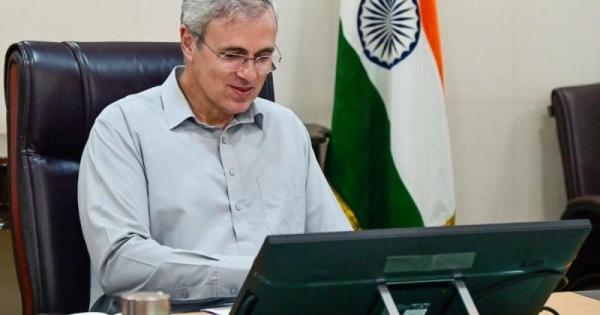
Jammu and Kashmir Chief Minister Omar Abdullah has taken a dig at the BJP-led NDA government at the Centre over the suspension of mobile internet services in Delhi.
He said the “Kashmir model” of restrictions had now reached the national capital, criticising the Centre by drawing a parallel between the internet restrictions in Delhi and those imposed in Jammu and Kashmir over the past several years.
On the social media platform X, Omar Abdullah wrote, “The Kashmir model has been implemented in Delhi. Welcome to the new New Delhi, modelled after the new Jammu and Kashmir.”
His remarks came after mobile internet services were suspended in parts of Delhi ahead of a planned protest.
Omar joins INDIA bloc leaders in meeting President
Omar Abdullah also joined leaders of the INDIA bloc in meeting President Droupadi Murmu to apprise her of their concerns over alleged “vote chori” and irregularities in the Election Commission’s handling of the Special Intensive Revision (SIR) of electoral rolls.
Reiterating the demand for Chief Election Commissioner Gyanesh Kumar’s resignation, Omar Abdullah said, “We want the deletions from voter lists, made only to benefit the BJP, to be reversed. Restore the older voter lists and clean up the electoral process.”
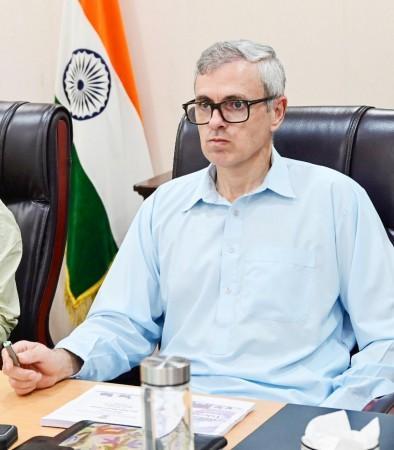
After meeting President Murmu, the Chief Minister said his party, the National Conference, had questioned the Election Commission over the delimitation exercise conducted in Jammu and Kashmir.
“The delimitation was carried out in J&K only to benefit the BJP. Seven seats were added, and the BJP won six of these seats,” he pointed out.
“We have been saying since then that the Election Commission was in connivance with the BJP to distort the people’s mandate in J&K. The same pattern is continuing,” he added.
Order to suspend mobile internet services
The Union Home Ministry has issued an order suspending mobile internet services within a four-kilometer radius of the Janpath-Kartavya Path intersection from 10 pm on October 9 to 10 pm on October 10. Issued under the Telecommunications Act, 2023, the order covers all mobile internet technologies.
The move comes ahead of a proposed demonstration at Jantar Mantar, where protesters are demanding the resignation of Chief Election Commissioner Gyanesh Kumar. The Delhi Police have refused permission for the demonstration, citing concerns over law and order, security, and traffic disruptions.
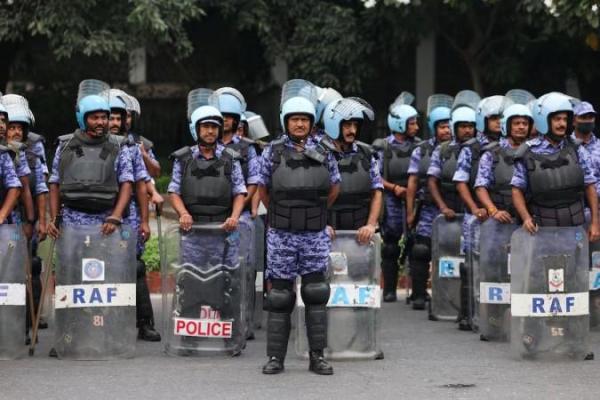
The restrictions were imposed on Saturday in view of a protest called by the Cockroach Janata Party (CJP) and left-wing student groups, which are demanding the CEC’s resignation.
The Delhi Police have enforced restrictions at several locations in central Delhi, with heavy barricading near Jantar Mantar, the site of a student agitation in July. Mobile internet services have also been suspended within a four-kilometre radius of central Delhi from 10 pm on Friday.
Separately, Indian Railways cancelled several trains scheduled to arrive in the national capital on Saturday, while the Delhi Metro announced the closure of 45 stations from 9 pm on Friday until 6 pm on Saturday.
Over 20,000 security personnel deployed in the capital
Security arrangements include the deployment of more than 20,000 personnel across the capital, the closure of 57 metro stations, seven layers of barricading, and the installation of more than 300 surveillance cameras.
Against this backdrop, Omar Abdullah’s remarks have triggered a fresh political debate over internet restrictions and the use of security concerns to justify such measures.
Contact to : xlf550402@gmail.com
Copyright © boyuanhulian 2020 - 2023. All Right Reserved.