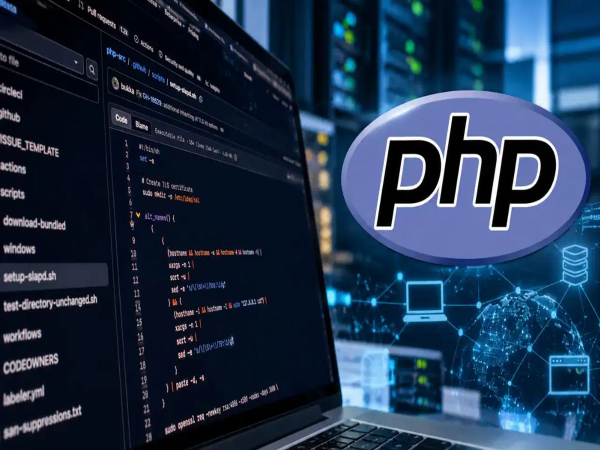
What is PHP? Whenever we open a news website on our mobile or computer, shop online, or fill out a form on a government portal, the entire page loads before us in a split second. On the screen, we see colorful images, text, and buttons. Yet, behind this polished interface, a technology operates around the clock—one whose name most average internet users have likely never heard.
That technology is called PHP. Recently, this three-letter acronym made global headlines when two major vulnerabilities forced the sudden shutdown of numerous government websites across Europe. Even the U.S. security agency, the NSA, had to issue an emergency alert. This raises the question: what exactly is PHP—the foundation upon which nearly the entire internet rests—and why does even a minor issue with it cause such alarm for governments worldwide?
What is PHP?
In technical terms, PHP is a programming language that powers websites. To understand it in simpler, everyday language, the analogy of a restaurant works best. When you visit a restaurant, you see the menu, tables, chairs, and decor. In the digital realm, this visible, external appearance of a website is constructed using languages like HTML. However, when you place an order with a waiter, the real work begins in the kitchen. The chef retrieves ingredients—vegetables, spices, and other essentials—from the pantry, prepares the dish, and presents a finished meal, which is then brought to your table by the waiter.
In the world of websites, PHP functions much like that chef, working behind the scenes—on the server. When you click a link to a website in your phone’s browser, you are essentially placing an order with the server. The PHP present there springs into action immediately. It gathers news, photos, your profile information, and necessary files from the server's database. It then assembles these elements to create a complete web page and delivers it to your mobile or computer screen in the blink of an eye. The user sees only the finished page, while all the heavy lifting is performed by PHP behind the scenes.
PHP powers 70 percent of websites worldwide.
This language forms the foundation for a vast portion of the internet as we know it today. Data from W3Techs, an organization that tracks web technologies, indicates that among all websites whose programming language can be identified, approximately 70 percent run on PHP. In other words, this engine powers 7 out of every 10 websites on the internet.
There are two primary reasons for its immense success. First, PHP is completely free and open-source. It is not owned by any single company; instead, volunteers from around the world collaborate to maintain and improve it. The second major factor is WordPress. WordPress, the world's most popular website-building software, runs entirely on the PHP engine. Today, about 40 percent of the world's websites are built on WordPress—ranging from personal blogs and pages for small businesses to large online shopping sites, news portals, and government websites. Interestingly, most website owners never interact with PHP directly, as it operates quietly in the background.
Why a single vulnerability can put millions of websites at risk.
While the widespread use of any technology offers convenience, it also introduces significant risk. Think of it this way: if 70 percent of the homes in a city used locks from the same manufacturer, and thieves discovered a way to open those locks without a key, every one of those homes would suddenly become vulnerable. This is precisely what has happened recently with PHP. Two vulnerabilities discovered in it have been assigned a critical severity rating of 9.2 out of 10 on the Common Vulnerability Scoring System (CVSS v4.0).
According to the European Union’s Computer Emergency Response Team (CERT-EU) and the U.S. National Security Agency (NSA), this type of flaw provides hackers with a path to access a website’s server and database directly, without requiring a password or an account. In technical terms, this is known as "unauthenticated remote code execution." As explained by the web hosting company GoDaddy, this means a hacker—operating from a remote location—could steal website data, deface web pages, or even take complete control of the entire system.
Small business owners and operators of smaller websites are the most severely affected in such a scenario. Large corporations and government entities typically have dedicated cybersecurity experts who can promptly take a website offline to perform system updates. In contrast, many smaller websites operate on "shared hosting"—imagine a single large server housing hundreds of individual websites. The owners of these sites generally lack dedicated security staff and do not manage the server infrastructure themselves; they may not even know who is responsible for updating the PHP software on their server. Wordfence, a security plugin for WordPress, has clarified that standard, automated website updates are insufficient to address a fundamental flaw of this nature.
Disclaimer: This content has been sourced and edited from TV9. While we have made modifications for clarity and presentation, the original content belongs to its respective authors and website. We do not claim ownership of the content.
Contact to : xlf550402@gmail.com
Copyright © boyuanhulian 2020 - 2023. All Right Reserved.