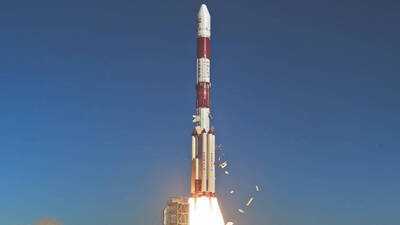
India's journey to Moon, Space Vision for Amrit Kaal and the opening of the space sector demonstrate how visionary leadership of Prime Minister Narendra Modi and govt, institutional resilience and collective ownership can transform ambitious national goals into extraordinary achievements.
India's successful landing of Chandrayaan-3 on Moon on Aug 23, 2023, was much more than a technological milestone. It represented the coming together of national vision, political leadership, institutional commitment, scientific determination and the collective efforts of thousands of people. It demonstrated an important principle of nation-building: extraordinary achievements become possible when individual aspirations are transformed into a shared national mission.
Having been closely associated with India's space programme, I see Chandrayaan-3 not as an isolated success, but as the outcome of decades of institution-building, technological development and perseverance. It offers valuable lessons on leadership, particularly in large national programmes.
The Indian space programme began in the early 1960s with very modest resources. The establishment of INCOSPAR in 1962, ISRO in 1969 and department of space in 1972 laid the foundations for national space capability. From sounding rockets at Thumba to sophisticated launch vehicles, satellites and planetary missions, India built technological capabilities through sustained commitment. Such a journey requires more than scientific excellence. It requires leadership that establishes a long-term vision and sustains institutional confidence.
One significant leadership moment was the articulation of India's Space Vision 2047 , approved by the minister as an aspirational goal for Amrit Kaal. It provided a long-term framework encompassing human spaceflight, Bharatiya Antariksh Station, advanced heavy-lift and reusable launch vehicles, sustained human presence in space and deeper lunar exploration, including an Indian landing on Moon. Equally important was financial approval for initial programmes.
Another leadership decision was opening the Indian space sector to private participation, followed by Indian Space Policy 2023. With ISRO established as a successful national agency, young entrepreneurs and innovators wanted to enter the domain. Recognising that the future scale and economic impact of space activities required capabilities beyond a govt organisation, the reforms created opportunities for private enterprises. The objective was not to diminish ISRO's role, but to expand collective capacity by enabling industry, start-ups and research institutions to contribute. Around 440 registered space-technology start-ups by August 2026 reflect this enthusiasm.
Chandrayaan-2 provides another important leadership lesson. Its landing attempt in Sept 2019 didn't achieve the intended soft landing. Yet, the response was not to abandon the ambition. The mission was examined, shortcomings analysed and improvements incorporated into Chandrayaan-3, with attention to landing-system robustness and uncertainties.
Chandrayaan-3 showed that failure, approached with openness and scientific discipline, becomes a source of institutional learning.
PM Modi's participation on Chandrayaan-3's landing day and interaction with the mission team gave the achievement wider public significance. Recognition of scientists and engineers, including women scientists and project leaders, reinforced that national achievements are built through collective effort at every institutional level.
Behind Chandrayaan-3 was an enormous organisational effort. This is where institutional leadership becomes critical. The role of a leader is not to provide every technical answer, but to create an environment in which the right questions are asked, technical disagreements are encouraged, decisions are based on evidence and competent teams are empowered to take responsibility. Problems must be reported without fear, and accountability must exist at every level. Excessive centralisation can delay decisions, while decentralisation without accountability can fragment an effort. Successful mission leadership requires a balance between the two.
Operational leadership matters equally. Engineers, technicians, scientists, quality-assurance personnel, industrial partners and ground teams determine mission reliability. Younger professionals bring new ideas; experienced colleagues contribute institutional knowledge. Integrating these strengths is essential.
The lesson extends beyond space. Large national programmes need clear objectives, continuity, coordination, ownership and a culture of learning. Gaganyaan, Bharatiya Antariksh Station, advanced launch vehicles and future lunar missions require capabilities of greater scale and partnerships among govt, public institutions, industry, universities and start-ups.
From Thumba to Chandrayaan-3, India's journey illustrates what sustained commitment and decisive leadership can achieve. Progress depends not only on technology but also on the institutions we build, the people we empower and the leadership that gives direction to their collective efforts.
(The writer, a former Isro chairman, is chancellor of Chanakya University)
Contact to : xlf550402@gmail.com
Copyright © boyuanhulian 2020 - 2023. All Right Reserved.