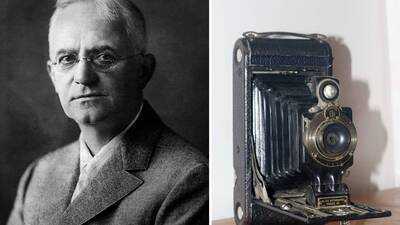
In the late 1870s, taking pictures was an elaborate undertaking. Cameras used to be bulky, the glass plates used to be heavy, and photographers had to prepare and develop their images with the help of chemicals before the plates dried. George Eastman faced these difficulties when he bought photographic equipment for a planned holiday to Santo Domingo. While he never made the trip, left him fascinated with photography , and he became determined to simplify it.
It is worth noting that Eastman was neither a professional photographer nor a chemist. Raised by his mother, Maria, after he lost his father in 1862, Eastman left school at the age of 14 to earn money. At first, he worked as an office boy at an insurance company before becoming a clerk at Rochester Savings Bank. By the time photography caught his attention, he worked at the bank during the day and pursued his experiments at home after hours.
Experiments in his mother’s kitchen
The first major challenge faced by Eastman was finding a way to avoid the cumbersome wet-plate process. According to the, he read British photographic publications describing gelatin emulsions that could be applied to glass plates and allowed to dry before use. Unlike wet plates, these dry plates could be prepared in advance and later exposed. He found a formula in one of those British publications and began making gelatin emulsions in his mother’s kitchen. He kept experimenting for about three years while continuing to work at the bank.
His continuous experiments produced more than just a usable photographic formula. Eastman also developed a machine that could coat glass plates with a more uniform layer of emulsion, thus making production faster. In September 1879, he applied for a patent, and US Patent No. 226,503, covering his method and apparatus for coating photographic plates, was granted on April 13, 1880. He began manufacturing dry plates commercially the same year in a rented space in Rochester.
Eastman soon realised that this could be turned into a business. With financial backing from Rochester businessman Henry A. Strong, he established the Eastman Dry Plate Company in January 1881. Later that year, he resigned from his job at the bank to focus more on the venture. The business then expanded beyond just selling glass plates as Eastman started looking for a lighter, more flexible material that photographers could carry without being cautious about the fragility of glass.
From paper film to Kodak camera
In 1885, the former bank clerk introduced a roll-film holder that could be fitted to nearly every plate camera available on the market at the time. It used light-sensitive emulsion coated onto paper, which was wound into a roll and advanced between exposures. The system became more portable because of the paper; however, it had a drawback. Its grain could affect the resulting photographs. Eastman’s company developed a process in which image-bearing emulsion could be separated from the paper after exposure and transferred to a clear support.
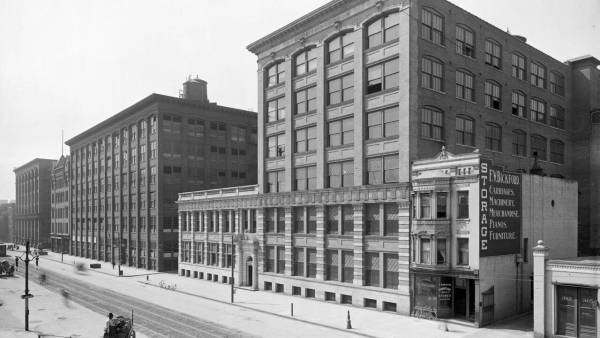 The next step included making the film itself transparent and flexible, thus removing the need for the paper-stripping process. In 1889, Eastman introduced commercial transparent roll film. It is important to distinguish this later improvement from the original Kodak camera. The 1888 model used strippable paper-based film and not the transparent celluloid roll film that followed.
Nevertheless, the 1888 Kodak camera marked a major turning point in how people could take photographs. The small box camera came preloaded with enough paper-based film for 100 exposures. The product was sold for $25, including its leather carrying case. To take a picture, the photographer needed to pull a string to set its rotating barrel shutter and press a button to make the exposure, then turn a key to advance the film.
The camera was only a part of Eastman’s wider ideas
Once all 100 exposures had been used, customers returned the entire camera to the company’s Rochester factory. According to , for an additional $10, the company removed and developed the film, printed the photographs, reloaded the camera and sent it back with the pictures. Therefore, customers could take photographs without having to develop negatives themselves.
Eastman also wanted a distinctive name for the camera company. In an interview, he once mentioned that he liked the letter K and experimented with combinations of letters before arriving at Kodak. The name was registered as a trademark in 1888. The business, which had become the Eastman Dry Plate and Film Company in 1884, was incorporated as the Eastman Kodak Company in 1892.
Contact to : xlf550402@gmail.com
Copyright © boyuanhulian 2020 - 2023. All Right Reserved.